1. Overview
The Huapen Gu (Flowerpot Drum) is a large, flared-body Chinese drum known for its deep resonance, sustained bloom, and powerful low-end projection. Unlike smaller handheld drums, its size, weight, and mounting height require specific postural alignment and controlled striking techniques to produce a clean, articulate, and tonally rich sound. This article outlines the fundamental playing posture—standing or seated—and introduces basic sound production methods suitable for beginners and intermediate players.
2. Basic Playing Posture
2.1 Standing Posture (Most Common)
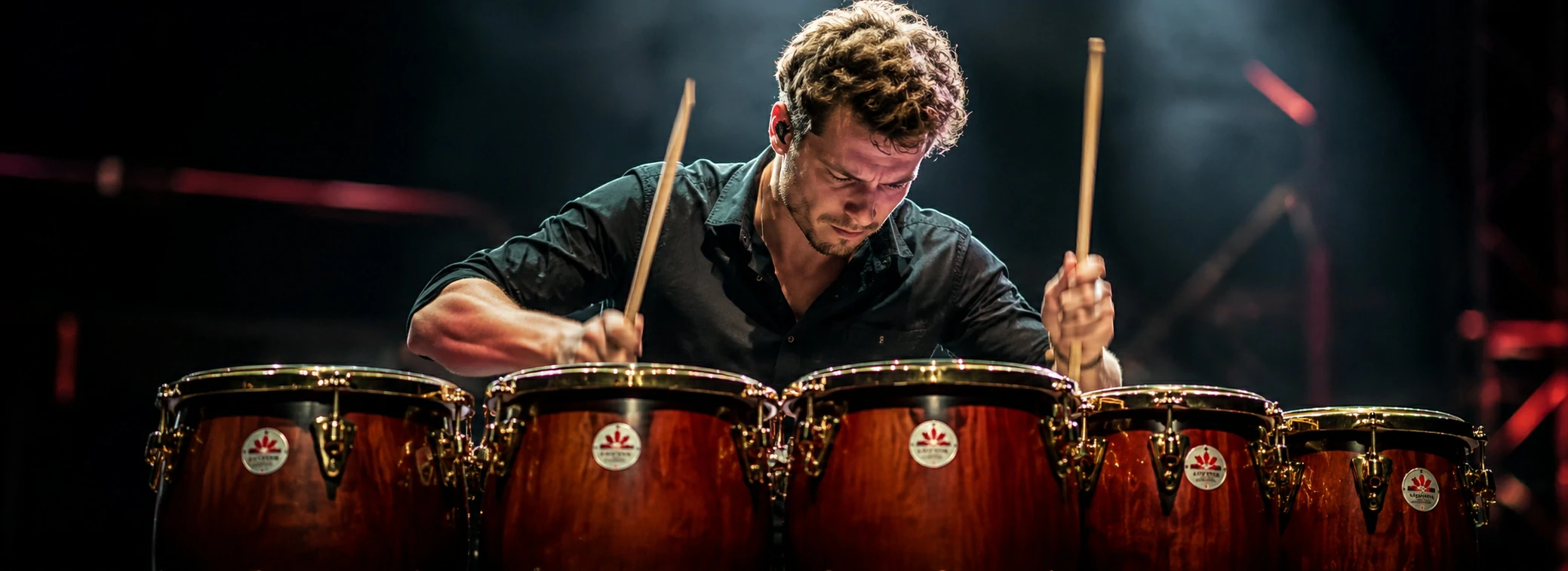
The Huapen Gu is usually mounted on a sturdy cradle or stand with the batter head angled slightly upward. Standing allows freer movement for large strokes and dynamic control.
Position Relative to the Drum:
Stand centered in front of the drum, roughly one step back from the stand to allow stick clearance.
The drum’s center should align roughly with your waist-to-lower-chest height when mounted, depending on adjustment.
Feet and Stance:
Adopt a shoulder-width stance for stability.
One foot may be slightly forward (left foot if right-hand-dominant leads slightly) to balance weight during full-arm strokes.
Avoid locking knees; maintain a relaxed, grounded posture.
Torso and Shoulders:
Keep the torso upright but not rigid; allow slight forward lean from the hips when reaching for lower strokes.
Shoulders should be relaxed and level—avoid raising the shoulders during preparation, which causes tension.
Arm and Stick Position:
Hold sticks using a matched grip (both hands symmetrical) or adapted Chinese grip if trained.
Forearms should be roughly parallel to the floor when sticks contact the head; elbows slightly away from the body.
Wrists are the primary movers for medium strokes; arms assist for full-power strokes.
2.2 Seated Posture (Orchestra Pit / Limited Space)
In some Chinese orchestra pits or compact stages, players may sit on a low stool or bench.
Seat Height:
Choose a seat so the drum’s batter head is at or slightly above chest level when seated, ensuring clear stick path.
Leg Position:
Feet flat on the floor, knees apart enough to allow arm movement but stable.
Avoid crossing legs or sitting too far forward/backward.
Upper Body:
Same principles as standing: upright spine, relaxed shoulders, balanced weight.
Leaning slightly forward from hips is acceptable to reach the drum comfortably without slouching.
2.3 General Postural Principles
Balance and Breathing: Maintain natural breathing; tension restricts rebound and tone.
Distance from Drum: Not too close (restricts stick arc) nor too far (overreaching causes strain).
Adjustability: Always set the stand height so the forearm–wrist–stick line feels natural; the Huapen Gu’s flare means the playing surface is wide—tilt adjustment helps optimize contact.
3. Stick Grip Basics (Matched Grip)
While traditional Chinese grip exists, matched grip is widely taught for Huapen Gu due to its power and symmetry.
Hold the stick about one-third from the butt end.
Thumb and index finger form a hinge; the other fingers wrap loosely to guide, not choke.
Stick pivots around the thumb–index fulcrum; allow rebound rather than pressing into the head.
Both hands mirror each other; practice relaxed drops to feel natural weight transfer.
4. Simple Sound Production Techniques
4.1 Center Stroke (Fundamental Tone)
Contact Point: Strike near the center of the batter head.
Motion: Use a controlled wrist turn with forearm support. Lift the stick to a moderate height (about 15–20 cm above head), then drop with gravity-assisted acceleration.
Sound Character: Full, deep fundamental with strong resonance and sustain—typical of the Huapen Gu’s low-end bloom.
Key: Let the stick rebound naturally; do not “bury” it in the head, which chokes the sound.
4.2 Edge Stroke (Bright Attack)
Contact Point: Strike 2–5 cm inward from the rim, depending on head size.
Motion: Similar to center stroke but with slightly more defined wrist snap.
Sound Character: Brighter, more articulate attack with reduced sustain; emphasizes higher overtones. Useful for rhythmic clarity and accents.
Caution: Avoid hitting the rim itself (rimshot) unless intended; on a large Huapen Gu this can be overly harsh and stress the head.
4.3 Soft Stroke (Controlled Light Touch)
Motion: Minimal stick lift (2–5 cm); rely on wrist finesse rather than arm weight.
Sound Character: Quiet, intimate, with clear pitch hint and controlled decay. Good for practice and dynamic sensitivity.
Focus: Finger and wrist control; keep grip relaxed to avoid a “dead” thud.
4.4 Full-Arm Stroke (Power Accent)
Motion: Involve the whole arm—shoulder relaxation, upper arm lift, then downward acceleration through forearm and wrist.
Used for: Fortissimo accents, ceremonial hits, or cutting through ensemble texture.
Sound Character: Massive attack, strong transient, deep projection. Requires the hide head to be well-tuned to avoid cracking.
Caution: Maintain posture stability; do not lean uncontrollably into the drum.
4.5 Roll (Basic Sustained Sound)
Open Roll (Multiple Bounce): Allow the stick to rebound several times by maintaining gentle downward pressure after the initial stroke.
Controlled Double/Single Alternation: For slower rolls, alternate hands with slight accent on each stroke.
On Huapen Gu: Rolls exploit the drum’s sustain and bloom; the flared shell enhances ringing decay.
Technique Tip: Keep wrists flexible; let the head’s rebound dictate roll density. Gradual dynamic swells (crescendo/diminuendo) are achieved by increasing/decreasing stroke energy and roll speed.
5. Dampening (Basic Articulation)
Stick Dampening: After a stroke, leave the stick briefly on the head to stop vibration for a clean staccato.
Hand/Finger Dampening: Use the free hand’s palm or fingers to touch the head near the edge (carefully, to avoid interfering with playing).
Purpose: Articulates notes in fast passages; prevents unwanted resonance from blurring rhythm.
6. Common Beginner Mistakes and Corrections
Mistake | Effect | Correction |
|---|
Rigid grip / tense wrists | Choked sound, fatigue | Practice relaxed rebound drops; shake out hands before playing |
Striking only at extreme edge | Harsh, thin tone, head stress | Use center/near-center for fundamental; edge for brightness |
Over-pressing into head | Kills sustain, muffled tone | Focus on rebound; lift stick naturally after impact |
Poor stance / overreaching | Loss of balance, inconsistent stroke | Adjust stand height; maintain shoulder-width stance |
Ignoring dynamic gradient | All strokes same volume | Practice pp–mf–f consciously with same technique |
7. Practice Suggestions for Posture and Sound
Mirror Practice: Watch posture—shoulders, grip, stick path.
Single Strokes at Center: Alternate hands slowly, focusing on even tone and rebound.
Contrast Drill: Play one stroke center (full tone), one near edge (bright), listening to difference.
Roll Development: Start slow open roll, gradually increase density while keeping evenness.
Dynamic Ladder: Play four strokes pp, four p, four mf, four f, then reverse—maintaining same contact point.
8. Conclusion
The Huapen Gu demands a stable, relaxed posture and a clear understanding of how stick contact, motion, and rebound shape sound. Standing (or seated) with balanced weight, relaxed shoulders, and proper stick grip lays the foundation. Basic techniques—center strokes for depth, edge strokes for brightness, controlled soft touches, power accents, and rolls—unlock the instrument’s characteristic resonance and bloom. As a large drum with strong acoustic presence, mindful posture and clean stroke mechanics not only protect the player from strain but also preserve the drum’s rich, singing voice.