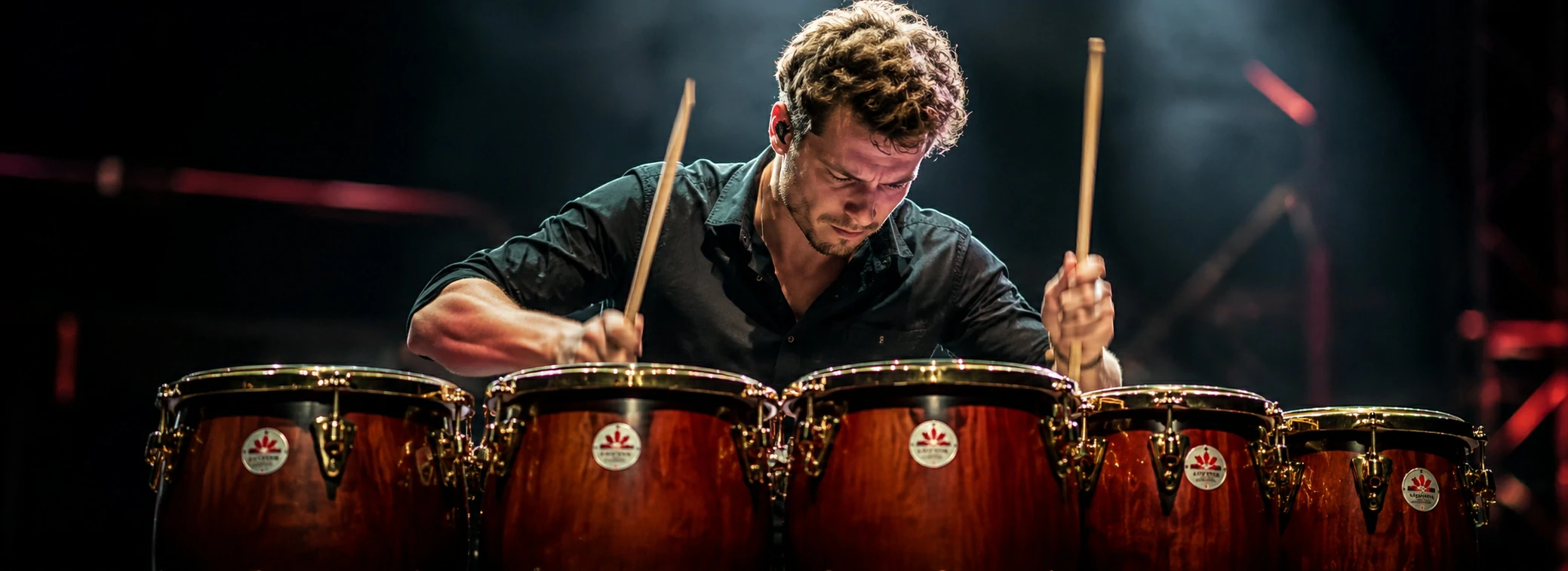
The Wuyin Pai Gu , or Five-Tone Rack Drums, is a modern Chinese pitched percussion instrument consisting of five tuned drums mounted on a single frame. Unlike the monolithic Da Tanggu, the Pai Gu is a system where specifications—including drum count, shell material, head type, diameter, and stand structure—define its acoustic character, portability, and suitability for different musical contexts. This article categorizes the common specifications and models found in professional, educational, and outdoor settings.
2. Classification by Number of Drums (Configuration)
While "Wuyin" implies five tones/drums, modern developments have expanded the family:
Wuyin Pai Gu (5-Drum Set): The standard configuration. Five drums are arranged from high to low pitch, typically covering a range of about an octave and a fifth to an octave and a half. Suitable for most Chinese orchestra and solo repertoires.
QiYin Pai Gu (7-Drum Set): An extended configuration with seven drums, broadening the pitch range to approximately two octaves. This allows for more complex melodic passages and is increasingly common in professional ensembles.
JiuYin Pai Gu (9+-Drum Set): A specialized, large-scale setup for soloists or avant-garde compositions requiring extreme range and timbral variety, though less common due to space and cost constraints.
3. Classification by Shell (Drum Body) Material
3.1 Traditional Solid Wood
Materials: Commonly Chunmu (Ailanthus altissima), Birch, Oak, or Ash.
Acoustic Traits: Produces a warm, complex, and "woody" resonance with rich overtones. Preferred for authentic timbre in concert halls.
Considerations: Sensitive to humidity and temperature; requires careful maintenance but offers superior acoustic depth.
3.2 Multi-Ply Laminated Wood
Materials: Cross-laminated plies of birch, maple, or poplar (typically 6–10 ply).
Acoustic Traits: More focused projection, consistent sound, and greater dimensional stability than solid wood. The standard for many institutional and touring instruments.
Considerations: Slightly less complex in overtone structure but highly durable and reliable.
3.3 Synthetic / Composite Materials
Materials: Fiberglass or carbon composite shells.
Acoustic Traits: Brighter, more direct attack; less low-end "bloom" than wood. Highly resistant to environmental changes.
Considerations: Ideal for outdoor performances, regions with extreme climates, or high-durability needs (e.g., marching, parades) where acoustic authenticity is secondary to reliability.
4. Classification by Drumhead (Membrane) Material
4.1 Natural Hide
Water Buffalo Hide: The professional standard. Thick, dense, and resonant with a complex harmonic spectrum. Requires climate control.
Cow Hide (Ox Hide): Slightly softer, sometimes used for medium sizes; less dense than buffalo but still traditional.
Single vs. Double Layer: Single layer (1.5–2.5mm) for concert use; double layer (3–5mm) for heavy-duty/outdoor use.
4.2 Synthetic Heads
Materials: PET/Mylar-based films (e.g., Remo-type synthetics).
Traits: Moisture-proof, temperature-stable, consistent pitch. Brighter and less complex than hide.
Use Case: Educational settings, outdoor gigs, or players in very humid/dry regions.
5. Classification by Tuning Mechanism
5.1 Mechanical Lug-Tuned (Bolt-Tension)
Mechanism: Metal lugs, tension rods, and hoops (similar to Western concert drums).
Features: Precise, repeatable pitch adjustment; stable tuning; the professional standard for orchestras and conservatories.
5.2 Rope-Tuned (Traditional Lacing)
Mechanism: Hemp or rawhide ropes wound around the flesh hoop and shell ribs.
Features: Authentic visual and traditional tension feel; however, tuning is labor-intensive, less precise, and highly sensitive to humidity. Mostly used in traditional opera, historical reenactment, or as display instruments.
6. Classification by Drum Diameter (Size Specification)
The five drums are numbered (typically No.1 = smallest/highest to No.5 = largest/lowest). Common diameter combinations include:
Standard Ensemble Set (Group A): Approx. 20 / 23 / 26 / 29 / 32 cm. The most common professional configuration, balancing agility and body.
High-Pitched / Bright Set (Group B): Approx. 18 / 20 / 23 / 26 / 29 cm. Emphasizes clarity and projection for soloistic or chamber use.
Mid-Low / Full-Body Set (Group C): Approx. 23 / 26 / 29 / 32 / 35 cm. Deeper resonance, suitable for low-end reinforcement in large ensembles.
Teaching / Compact Set: Approx. 15 / 18 / 20 / 23 / 26 cm. Smaller, lighter, more portable for students and small spaces.
Expanded Range (for 7-drum sets): Often extends from ~18 cm up to ~38–43 cm to cover wider pitch spans.
Note: In some numbering systems, No.1 is the largest (lowest) and No.5 the smallest (highest); always verify the maker's specification.
7. Classification by Stand (Rack) Structure
7.1 Integrated Single-Beam Rack
A single curved or straight with pre-set cradles for five drums.
Pros: Stable, quick to set up, consistent spacing.
Cons: Less adjustable; harder to transport in one piece.
7.2 Modular / Split Rack (2+3 or Individual)
The rack splits into sections (e.g., 2 drums + 3 drums) or uses independent adjustable arms on a vertical post.
Pros: Highly portable, adjustable spacing/angle, fits varied stages.
Cons: More complex setup; requires careful leveling.
7.3 Specialist / Soloist Rack
May include height-microadjustment, tilting precision locks, or wheeled bases for solo performers who need to reposition frequently.
Often heavier-duty with outrigger legs for stability during virtuosic playing.
8. Classification by Intended Use / Model Series
Model Type | Typical Specs | Target Context |
|---|
Professional / Concert Model | Solid/high-grade laminated wood, buffalo hide, mechanical lugs, adjustable rack, Group A/B sizes | Chinese orchestras, conservatories, soloists |
Educational / Student Model | Laminated wood or composite, synthetic or mid-grade hide, simplified rack, compact sizes | Schools, beginners, practice |
Outdoor / Touring Model | Composite shell or sealed wood, synthetic heads, reinforced hardware, stable split rack | Parades, outdoor festivals, touring troupes |
Traditional / Replica Model | Solid wood, rope-tuned, traditional lacquer, historical diameter sets | Opera research, museums, period performance |
9. Summary Table of Key Specification Axes
Axis | Main Categories |
|---|
Drum Count | 5, 7, 9+ |
Shell Material | Solid Wood (Chunmu/Birch), Laminated Ply, Fiberglass/Composite |
Head Material | Water Buffalo Hide, Cow Hide, Synthetic (PET) |
Tuning | Mechanical Lug, Rope-Tuned |
Diameter Set | 18–29cm (Bright), 20–32cm (Standard), 23–35cm (Full), 15–26cm (Edu) |
Rack Type | Integrated Beam, Split/Modular, Soloist Adjustable |
Use Case | Professional, Educational, Outdoor, Traditional |
10. Conclusion
The Wuyin Pai Gu is not a monolithic instrument but a family of configurations. Its specification is defined by the interplay of drum quantity, material science (shell/head), tuning mechanics, dimensional sets, and stand ergonomics. Selecting the appropriate model requires aligning these technical categories with the practical demands of the performance environment—whether the warm complexity of a concert hall, the durability required for outdoor stages, or the ergonomic simplicity needed for education. Understanding these classifications ensures the instrument serves its role as both a rhythmic anchor and a melodic voice within the modern Chinese percussion landscape.