1. Overview
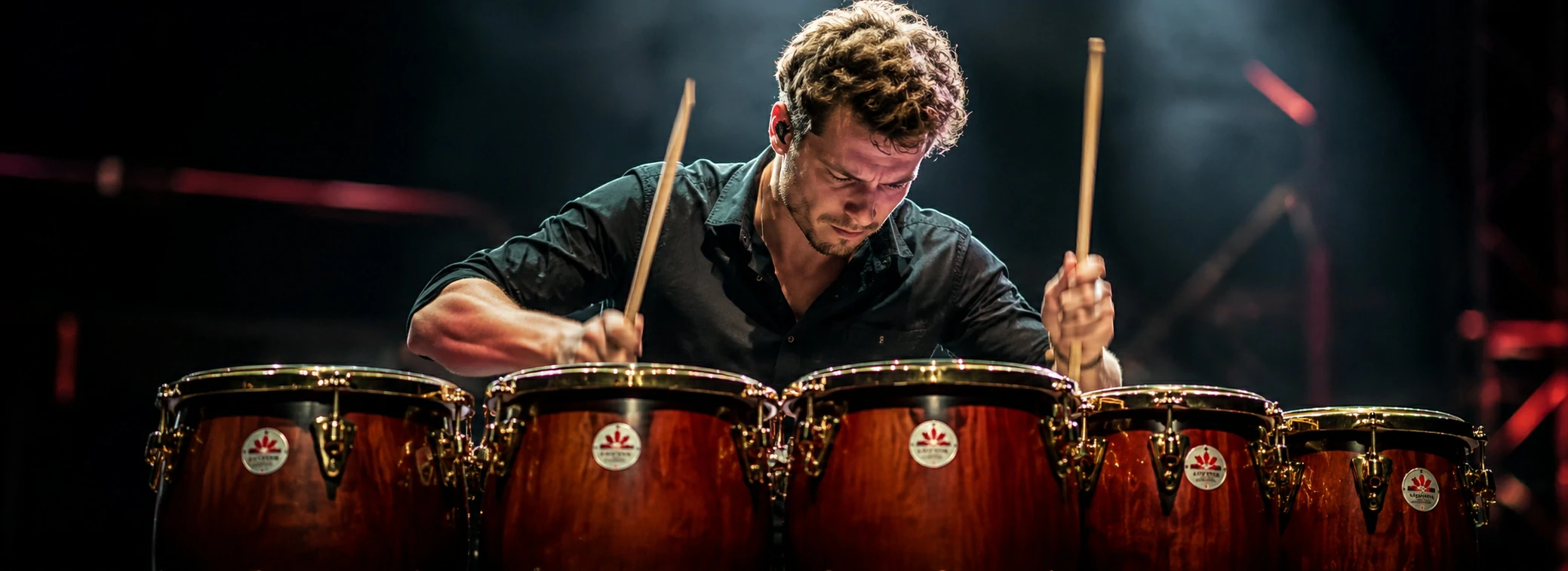
The Wuyin Pai Gu (Five-Tone Rack Drums) is a cornerstone of the modern Chinese percussion ensemble. In Ji'nan—a city with a deep-rooted tradition in Shandong folk music (Shandong Guchui) and a thriving contemporary conservatory scene—mastering the instrument requires a specific approach to rhythm. This guide outlines technical exercises and practice methodologies tailored to the demands of Ji'nan-style playing, balancing the precision required for orchestral works with the raw energy of local folk traditions.
2. Foundational Principles: The Ji'nan Aesthetic
Before specific exercises, one must understand the rhythmic philosophy prevalent in Ji'nan:
Clarity over Speed: Ji'nan styles (influenced by Lu Opera and local drum-singing) prioritize clear, articulate strokes where every note has weight.
The "Iron Beat" (Tiebang): A concept emphasizing a solid, unwavering pulse, even during complex embellishments.
Dynamic Storytelling: Rhythm is not just time-keeping; it mimics the cadence of local dialects and the physicality of Shandong martial arts.
3. Basic Stroke Mechanics for Rhythmic Precision
3.1 The "Full Stroke" Exercise
To build a consistent rhythmic foundation:
Set a metronome to 60 BPM (Quarter Notes).
Play whole notes on the lowest drum (Drum 5): One stroke per bar, focusing on a deep, resonant tone.
Move to half notes, then quarter notes, maintaining the same physical motion and rebound.
Goal: Ensure the stroke lands exactly with the click. In Ji'nan training, if the stroke is early or late, the student restarts the bar.
3.2 The "Controlled Bounce" (Rebound Control)
Many Ji'nan folk patterns use rapid double strokes that rely on the head's natural rebound.
Practice double strokes (RR LL) on a single drum at slow tempos (60–80 BPM).
Focus on letting the stick bounce twice naturally rather than forcing the second stroke.
Ji'nan Variation: Once comfortable, play accented doubles: Rr Ll Rr Ll (Capital = Accent). This builds the control needed for the explosive accents found in Shandong drumming.
4. Developing Independence: The "Cross-Rhythm" Approach
The Wuyin Pai Gu requires the hands to move independently across five drums. Ji'nan pedagogues often use "mapping" exercises.
4.1 Linear Mapping
Assign a specific rhythmic value to a specific drum to visualize the pattern.
Exercise: Metronome at 80 BPM.
Right Hand: Plays quarters on Drum 1 (High).
Left Hand: Plays eighths on Drum 5 (Low).
Progression: Swap hands. Then move the Right Hand to Drum 3 and the Left to Drum 4. This builds a mental map of the rack.
4.2 The "Ji'nan Waltz"
A common folk rhythm in the region is a heavy 3/4 pattern.
Pattern: Drum 5 (Low) - Drum 1 (High) - Drum 3 (Mid).
Sticking: R - L - R.
Feel: The Low drum is the "root," the High drum is the "spark," and the Mid drum is the "bridge." Practice this until the transition between the far-left and far-right drums feels fluid.
5. Incorporating Traditional Rudiments (Lu Style)
Shandong drumming (Lu Guchui) is famous for its use of Flams (Guayin) and Drags (Shuangyin) to create a dense, rolling texture.
5.1 The Flam (Grace Note + Main Note)
Standard Flam: Play a very fast L-R or R-L where the first stroke is a ghost note and the second is an accent.
Ji'nan Application: Place the Main Note on the low drum and the Grace Note on a higher drum. This creates a "crashing" wave effect.
Exercise: Play flams on every beat at 70 BPM. Move the flam around the rack (Low-High, High-Mid, Mid-Low).
5.2 The Drag (Two Grace Notes + Main Note)
Standard Drag: LL-R or RR-L.
Ji'nan Application: Use drags to fill the space between heavy beats. In a 4/4 pattern, play Drag - Rest - Beat - Rest.
Focus: The two grace notes should be extremely fast and light, leading into a heavy main stroke. This is the rhythmic engine of many Ji'nan opera overtures.
6. Polyphonic Practice: Hands and Feet
While the Wuyin Pai Gu is primarily a hand instrument, advanced Ji'nan players coordinate with the Datanggu or Bo (Gong). Even when practicing solo, you can simulate this.
6.1 The "Shadow Foot" Technique
Concept: Use your left foot to tap the pulse while your hands play a counter-rhythm.
Exercise:
Foot: Steady quarters on the floor.
Hands: Play a syncopated pattern like Rest - R - L - R.
Benefit: This develops the "internal clock" necessary for playing in a large Chinese orchestra where the percussion section is the timekeeper.
7. Practicing Folk Tunes and Repertoire
To internalize the Ji'nan rhythmic language, one must play the music of the region.
7.1 "Bajiaoguzhang" (Octagonal Drum Melody) Rhythms
Learn the basic rhythmic cells (Yizi). These are short, repeating patterns often based on the lyrics of local drum songs.
Exercise: Loop a 4-bar rhythmic cell from a Lu Opera piece. Focus on the "swing" or slight hesitation often found before the final beat of the phrase—a hallmark of Ji'nan phrasing.
7.2 Call and Response
Record yourself playing a simple rhythmic phrase (the "Call") on the high drum.
Play it back and respond with a complementary phrase (the "Response") on the low drum.
This mimics the dialogue between the drum and the Suona in traditional Ji'nan ensembles.
8. Metronome Discipline and "Micro-Timing"
Ji'nan masters emphasize playing with the metronome, not just on it.
The "Push and Pull" Exercise:
Practice playing slightly ahead of the click (rushing) for 4 bars, then slightly behind (dragging) for 4 bars.
Goal: To feel the tension of rushing and the relaxation of dragging, eventually settling into the "pocket" right on the beat. This is crucial for the expressive rubato found in traditional music.
9. Summary of Practice Routine (Ji'nan Method)
Duration | Focus | Technique |
|---|
10 min | Warm-up | Full strokes, Rebound control |
15 min | Rudiments | Flams and Drags across the rack |
15 min | Independence | Linear mapping, Shadow foot |
20 min | Repertoire | Lu Opera patterns, Folk tunes |
5 min | Timing | Push/Pull with metronome |
10. Conclusion
Mastering rhythm on the Wuyin Pai Gu in Ji'nan is not merely about mechanical repetition. It is about cultivating a physical and mental discipline that honors the "Iron Beat" while embracing the lyrical flexibility of Shandong culture. By focusing on stroke clarity, independence, and the integration of traditional rudiments, a player can develop a rhythmic voice that is both technically precise and deeply rooted in the rich musical soil of Ji'nan.