1. Overview
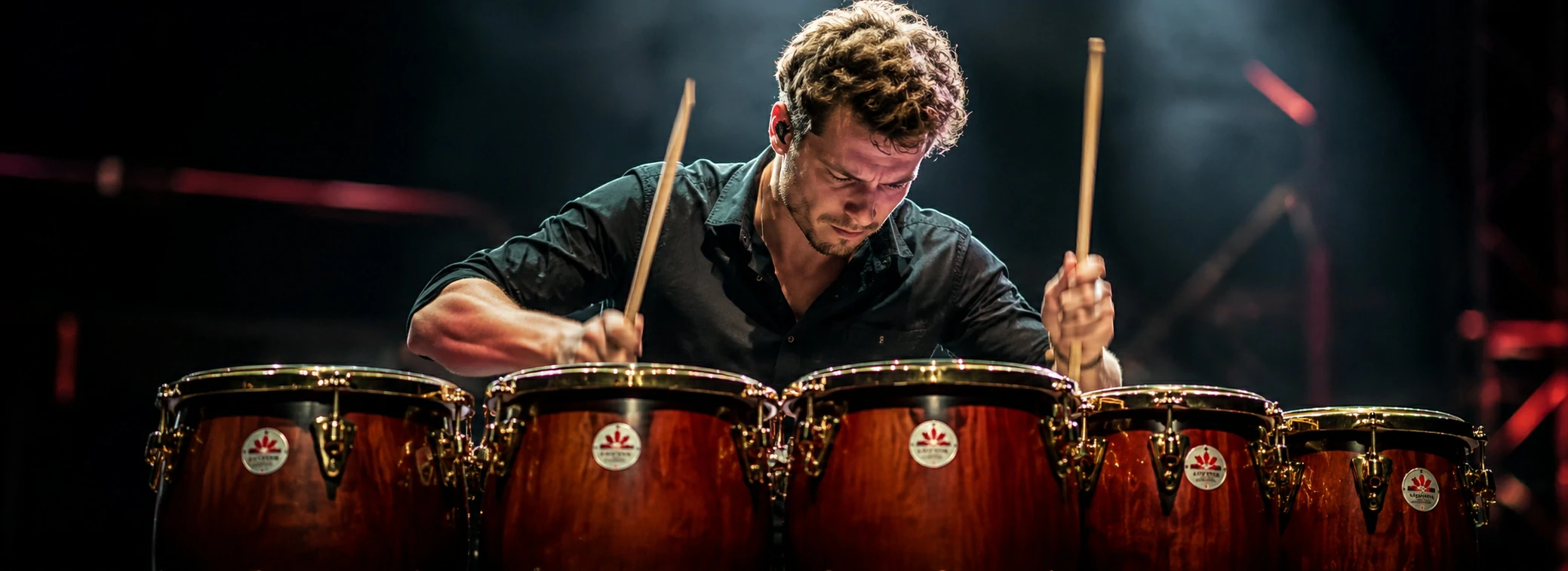
Row Drums, known in Chinese as Pai Gu , most prominently represented by the Wuyin Pai Gu (Five-Tone Row Drums), are a modern family of pitched Chinese membranophones. Unlike the monolithic Da Tanggu or the shallow Biangu, the Pai Gu consists of multiple individually tuned drums mounted on a single rack. Their tonal identity is defined by a combination of definite pitch, melodic capability, controlled resonance, and timbral gradation across the set. This article analyzes the acoustic and expressive tone characteristics of row drums in detail.
2. Fundamental Tonal Identity: Definite Pitch
The primary tonal characteristic that distinguishes Pai Gu from traditional unpitched Chinese drums is pitch definability.
Pentatonic Tuning: The standard five-drum set is tuned to a Chinese pentatonic scale (Gong, Shang, Jiao, Zhi, Yu), such as G3–A3–B3–D4–E4. Each drum produces a clear fundamental frequency recognizable by the human ear and measurable by a tuner.
Interval Consistency: Well-crafted Pai Gu maintain pure intervallic relationships. The pitch does not "wobble" excessively due to even head tension and symmetrical shell construction.
Acoustic Implication: This allows the instrument to play melodies, arpeggios, and harmonic rhythms rather than purely percussive timekeeping, functioning similarly to a timpani or pitched tom-tom in a Western context but with a distinct membranous, woody Chinese character.
3. Spectral and Timbral Characteristics by Drum Size
Because the set comprises five drums of increasing diameter and depth (typically from ~20 cm to ~35 cm), the tonal spectrum spans from bright/crisp to deep/resonant.
3.1 High-Pitched Drums (Small Diameter, e.g., 20–25 cm)
Attack: Extremely crisp, penetrating, and articulate. The initial transient is sharp and "pingy."
Sustain: Short to moderate decay; the sound dissipates quickly, emphasizing clarity over boom.
Overtones: Rich in high-order overtones; less low-mid body. The timbre is often described as solid, bright, and aggressive .
Role: Ornamental passages, fast rhythmic figures, cutting through dense ensembles (cymbals, suona).
3.2 Mid-Range Drums (Medium Diameter, e.g., 26–29 cm)
Attack: Balanced between brightness and warmth. Clear but with more body than the high drums.
Sustain: Moderate, controlled resonance. Capable of short rolls that blend without overpowering.
Overtones: Mixed high and low overtones; a more neutral, versatile tonal center.
Role: Connecting melodic lines, supporting mid-register winds/strings, general rhythmic drive.
3.3 Low-Pitched Drums (Large Diameter, e.g., 32–35 cm)
Attack: Slightly softer initial impact due to larger membrane mass, but still defined.
Sustain: Longer, fuller, and more singing . The low-mid and fundamental frequencies are prominent.
Overtones: Strong low-order overtones; complex, warm halo around the note.
Role: Foundation pitches (Gong tone), dramatic crescendos, sustained rolls, grounding the harmonic/rhythmic structure.
4. Resonance and Decay Control
The Pai Gu’s shell geometry (moderate depth, straight or slightly tapered barrel) and head material influence its resonance profile:
Head-Dominated Resonance: Unlike deep drums (Da Tanggu) where air-column resonance dominates, Pai Gu sound is membrane-driven with moderate cavity contribution. This results in a controlled decay—not as dry as a Biangu, not as booming as a Da Tanggu.
Sustain Management: Players can control decay via:
Stroke type: Open strokes yield more sustain; stopped strokes (hand dampening) yield staccato.
Mallet hardness: Hard felt/wood shortens decay; soft felt lengthens it.
Tension: Higher tension increases brightness and shortens sustain; lower tension adds warmth and ring.
Blend Character: The controlled sustain allows multiple drums to be played rapidly without a muddy overlay of ringing overtones—a key trait for melodic execution.
5. Timbral Modulation: Strike Zones and Technique
A single Pai Gu drum offers multiple timbres depending on where and how it is struck:
Center Strike:
Maximum excitation of the fundamental mode.
Deepest, fullest tone with strongest low-mid energy.
Used for pitch definition and melodic notes.
Edge Strike (2–5 cm from rim):
Emphasizes higher overtones, reduces fundamental amplitude.
Brighter, sharper, more "crack"-like sound.
Used for articulation, accents, and contrasting timbres within a phrase.
Rim Shot (Stick on rim + head):
Sharp, woody "crack" with metallic-like attack.
Used sparingly for dramatic punctuation (more common in folk/opera than orchestral Pai Gu).
Roll Technique:
Open (multiple bounce): Sustains a shimmering, pitched wash.
Controlled (double stroke): Articulate, rhythmic roll with discernible pulses.
The Pai Gu’s ability to sustain a pitched roll is a core tonal asset, enabling legato expression uncommon in unpitched drums.
6. Material Influence on Tone (Shell and Head)
Shell Material:
Solid Hardwood (Chunmu, Birch): Warmer, more complex overtones; slight high-frequency diffusion; “woody” character.
Laminated Ply: More focused, direct projection; brighter attack; consistent, less ambient “bloom.”
Head Material:
Water Buffalo Hide: Organic, rich, slightly nonlinear overtones; sensitivity to humidity alters tone (drier = brighter/higher, damper = mellower/lower).
Synthetic (PET): Cleaner, more uniform overtones; brighter, less complex; stable but potentially “sterile” compared to hide.
Bearing Edge: A smooth, precise edge promotes clear fundamental; a rounded edge softens attack slightly.
7. Ensemble Tonal Role
Within a Chinese orchestra or folk ensemble:
Melodic Voice: Can double or answer melodic lines from Suona, Sheng, or Yangqin.
Rhythmic-Color Bridge: Fills the gap between unpitched percussion (Luo/Bo) and pitched strings/winds.
Dynamic Sculptor: The graded tonal range allows for crescendo/diminuendo across the set—starting a phrase on a high, crisp drum and rolling down to a deep, resonant low drum creates a powerful wave of tonal and dynamic motion.
8. Summary of Core Tone Characteristics
Characteristic | Description |
|---|
Pitch | Definite, pentatonic, tunable via mechanical lugs |
Spectrum | Bright/Crisp (small) → Full/Deep (large) |
Resonance | Controlled, head-dominated, moderate decay |
Timbral Range | Center (full fund.) vs. Edge (bright overtones) vs. Roll (sustained wash) |
Material Color | Hide = organic/warm; Wood = complex; Ply = focused |
Expressive Trait | Melodic capability, dynamic gradation, articulative clarity |
9. Conclusion
The tone characteristics of row drums (Pai Gu) are defined by their pitched melodic nature, size-graded timbral spectrum, and controlled, expressive resonance. They are neither purely rhythmic timekeepers nor fully sustained melodic instruments, but a hybrid: capable of crisp articulation, singing rolls, and definite-pitch intervals, all colored by the organic complexity of hide and wood. This unique tonal identity allows them to serve as both the rhythmic engine and a lyrical voice within the modern Chinese percussion section, adaptable from the bright clarity of a Shandong folk tune to the nuanced demands of a contemporary orchestral composition.