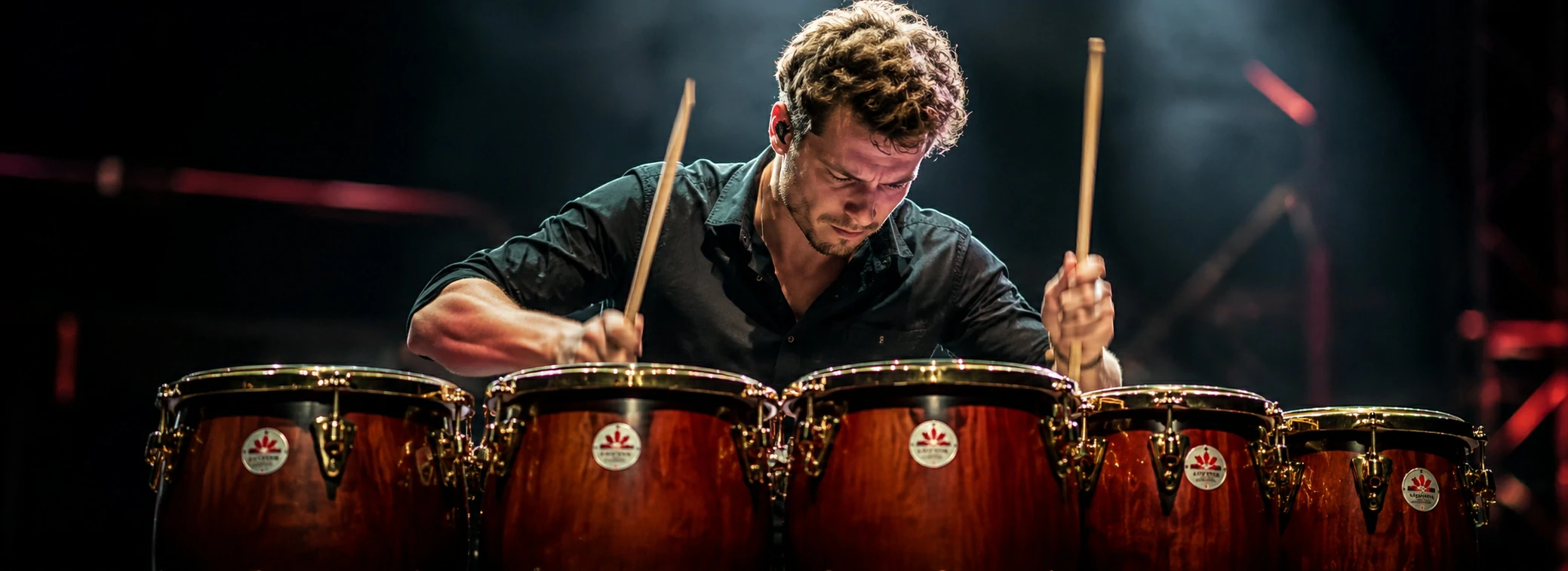
Detailed explanation of basic playing techniques for five-tone drumming
Release time :2026-10-20 13:36:32 Hits :15
一、Core mallet technique
1. Traditional style
With the palm of your left hand facing up, use your thumb, index finger, and middle finger to grip the back of the mallet shaft, and rotate your wrist inward. Use a standard grip for your right hand.
The way of exerting force differs between the left and right hands, with the left hand exhibiting a larger range of motion and a softer tone.
Suitable for passages with complex rhythms on the snare drum, where the left hand needs to be emphasized.
2. Symmetrical expression
Place the palms of both hands facing each other, grasp the back of the mallet with the thumb and index finger, relax the wrist, and use the forearm and wrist as the points of force application.
The exertion of force from both hands should be symmetrical, with small amplitude of motion, fast speed, and precise control.
It is suitable for most modern music scenes, especially for various techniques that require speed and strength.
二、Basic striking techniques
1. Click
A single, decisive strike, powered by the wrist, drives the drumstick to naturally fall and rebound.
The key is to relax the arm after exerting force, and utilize the natural rebound of the drum skin to achieve even strength and consistent tone.
2. Double-click
Use the same hand to strike the drumhead twice consecutively at the same point.
The dynamics, pitch, and timbre of the two strikes need to be highly consistent.
3. Triplets
Strike three times evenly within one beat. A basic fingering combination is right, left, right.
Maintaining a relatively uniform duration is the foundation for perceiving swaying rhythms and playing complex instrumental interludes.
4. Quadrature
Strike four times evenly within one beat. A basic fingering combination is right, left, right, left, also known as alternating single strikes.
This is the backbone of modern music rhythm, which requires practice to maintain stability and uniformity at any tempo.
三、 Complex rhythm technique
1. Single jump
Completing a double-tap with one hand emphasizes speed and control.
2. Double jump
Complete a double-click with alternating hands, that is, right-right-left-left.
It serves as the foundation for playing rapid and even rolls. When practicing, ensure that the two strikes are identical in terms of intensity and tone.
3. Compound jump
Fixed fingering exercises composed of single, double, and triple notes in different sequences.
The goal is to develop the independence, coordination, and control over complex rhythmic patterns of both hands.
4. Rolling
Through rapid and even alternating single clicks, a continuous, seamless, and dense sound flow is formed.
Uniform intensity is the core, and it should sound like a sustained long note. It is an important means to create momentum and connect phrases.
四、 Exercises for Separating and Coordinating the Limbs
1. Basic coordination mode
Pattern A: Step on the bass drum with your right foot, hit the hi-hat with your right hand, and play the off-beat on the snare drum with your left hand. This is the fundamental rhythm of rock and pop music.
Pattern B: Based on Pattern A, add left foot hi-hat opening and closing, or add ornamentation with the right hand on the tom-tom.
2. Door filling
At the phrase transitions, break the basic rhythmic pattern and use a combination of tom-tom, snare drum, and cymbal to play short phrases with a melodic feel and propulsive force.
Start practicing with simple triplets on snare drum, high tom-tom, and low tom-tom.