I. What Is the Traditional Five-Tone Pai Gu?
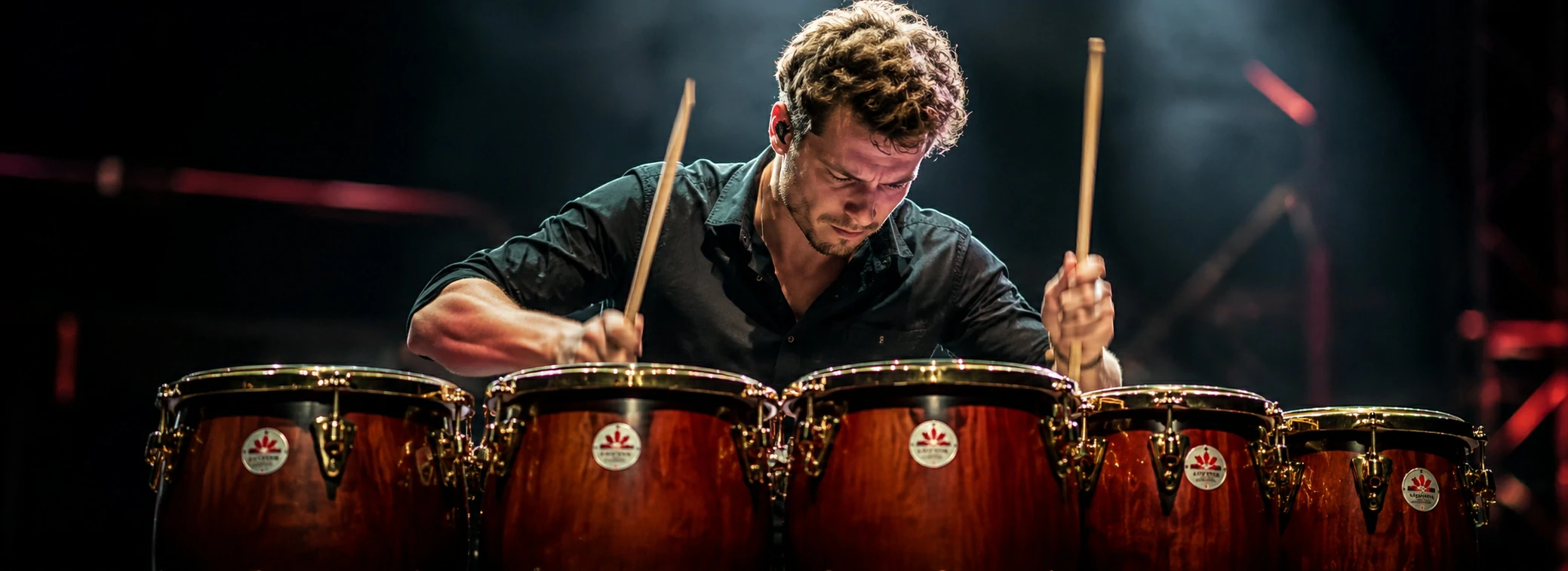
The traditional five-tone pai gu is a pitched drum set among Chinese national percussion instruments, consisting of five single-headed drums of different sizes with progressively rising pitches fixed on a dedicated rack. Arranged from low to high pitch from left to right, the five drums correspond to the ancient Chinese pentatonic scale: Gong, Shang, Jue, Zhi, Yu (Do, Re, Mi, Sol, La).
Evolved from folk hall drums and waist drums during the national orchestra reform in the mid-20th century, this instrument was finalized by professional musical instrument factories and has become standard equipment in the percussion section of Chinese national orchestras.
II. Structural Features of Traditional Five-Tone Pai Gu
| Component | Feature Description |
|---|
| Drum Shell | Wooden shells commonly made of rosewood, Chinese toon wood or birch, with a wall thickness of 8–15 mm. The inner surface is smoothly lathed to optimize resonance. |
| Drumhead | Cowhide heads (water buffalo hide or yellow cowhide). Tanned and tension-treated before being stretched over one end of the shell to deliver rich, mellow timbre. |
| Drum Hoop / Pressure Ring | Hoops made of metal or bamboo. Bolts or ropes fasten the hide to the shell, allowing tension adjustment. |
| Tuning System | Most traditional pai gu feature fixed pitches with little tuning range. Pitch is altered by replacing drumheads or adjusting hoop tension. |
| Drum Rack | Floor-standing frames of steel or timber. Five drum holders are arranged in an arc with adjustable height and angle. |
| Mallets | Hardwood mallets with a 2–3 cm diameter head and a slender grip end. Larger heads for low-pitch drums and smaller heads for high-pitch drums. |
III. Core Characteristics of Traditional Five-Tone Pai Gu
-
Pentatonic Arrangement Matched to Chinese Modal Music
The five drums are ordered by pitch following Do, Re, Mi, Sol, La (Gong-Shang-Jue-Zhi-Yu), naturally compatible with the tonal systems of national orchestral and opera music. Performers can swiftly shift between drums to play melodic fragments and rhythmic embellishments.
-
Layered Timbre: Deep Bass and Crisp Treble
- Low-pitch Drum No.1 (30–35 cm diameter): Deep, resonant and sonorous tone
- Mid-pitch Drums No.2 & 3 (25–30 cm diameter): Full, rounded timbre
- High-pitch Drums No.4 & 5 (20–25 cm diameter): Bright, piercing sound with strong penetration
The timbres transition smoothly across the set, forming a complete tonal gradient.
-
Natural Warm Timbre of Cowhide Heads
Hand-tanned traditional cowhide retains the natural fiber structure of animal skin. It generates warmer, fuller sound with abundant overtones compared to synthetic heads. Cowhide is sensitive to temperature and humidity, leading to subtle tonal shifts that create the unique charm of traditional instruments.
-
Diverse Playing Techniques with Rich Expressiveness
- Single Stroke: Individual hits on separate drums for single notes or rhythmic patterns
- Roll: Rapid alternating strikes on one head to create sustained sound
- Double Stroke: Two consecutive hits on a single drum for emphasis and ornamentation
- Glissando Sweep: Mallets slide quickly along the drum edge to produce special sound effects
- Cross-Drum Melody Playing: Fast movement across all five drums to perform full melodic and rhythmic passages
-
Perfect Compatibility with National Orchestra Configurations
It undertakes melodic roles within the percussion section of Chinese national orchestras. It pairs well with ban drums, hall drums, gongs and cymbals, and fits perfectly into rhythmic passages of opera percussion suites such as Peking Opera and Hebei Bangzi.
-
Fixed Pitches for Easy Operation
Traditional pai gu mostly retain fixed pitches with no need for tuning before each performance. They suit quick scene changes and group rehearsals and maintain relatively stable pitch despite environmental fluctuations.
IV. Comparison with Other Traditional Percussion Instruments
| Comparison Item | Traditional Five-Tone Pai Gu | Hall Drum | Ban Drum | Western Timpani |
|---|
| Drumheads per Set | 5 as one complete set | 1 single head | 1 single head | 2–4 as one set |
| Pitch Layout | Pentatonic graduated pitches | Single fixed pitch | Single fixed pitch | Fully adjustable pitches |
| Timbre Traits | Full layered low, mid and high tones | Deep and heavy | Sharp, piercing bright sound | Broad, rich resonant tone |
| Playing Posture | Seated, striking all drums with both hands | Standing or seated | Seated, one hand holds a wooden board beater | Standing, two mallets |
| Primary Function | Melodic rhythm & ensemble performance | Rhythmic backbone & atmosphere building | Rhythmic conductor & opera accompaniment | Symphonies & Western orchestras |
| Tuning Method | Fixed pitch or minor tension adjustment | Fixed pitch | Fixed pitch | Foot pedal tuning |
V. Main Application Scenarios
| Scenario | Explanation |
|---|
| Chinese National Orchestras | Takes melodic percussion roles in ensemble works, playing rhythmic embellishments, transitional phrases and independent drum solos. |
| Opera Accompaniment | Executes traditional percussion suites for Peking Opera, Hebei Bangzi, Ping Opera, matching performers’ movements and vocal rhythms. |
| Chinese Folk Music Concerts | Appears as solo or ensemble instrument to showcase the melodic and technical capabilities of Chinese percussion. |
| School Music Education | Used for rehearsals and teaching in primary, secondary and university national orchestras to help students grasp percussion rhythms and pitch concepts. |
| Folk Festivals & Temple Fairs | Performs lively, cheerful drum beats at folk celebrations to boost festive atmosphere. |
| Film & Stage Soundtracks | Provides distinctive Chinese percussion sound for ancient costume dramas, Chinese dances and stage plays. |
VI. Representative Works & Playing Styles
| Work Category | Representative Pieces | Performance Style |
|---|
| Solos | Rhythm of Drums, Pai Gu Solo | Highly technical, highlighting cross-drum playing and roll control |
| Ensemble Works | Dancing Dragons and Leaping Tigers, Harvest Percussion | Vigorous, energetic rhythms with coordinated interplay with the full orchestra |
| Concertos | Percussion Concerto | Features solo pai gu alongside a national orchestra to fully display the instrument’s expressive range |
| Opera Percussion Suites | Rapid Storm, Four Beats Opening (Peking Opera) | Distinct, crisp rhythms coordinating opera vocal lines and stage movements |