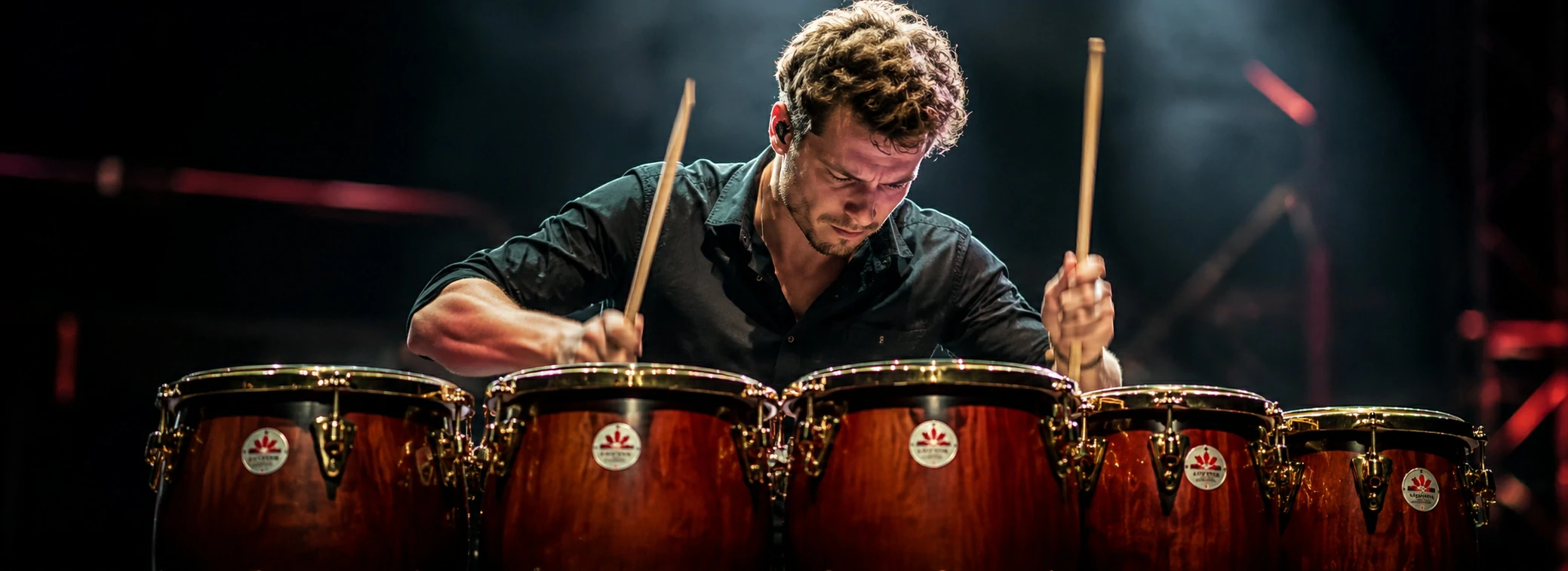
The Wuyin Pai Gu is a modern Chinese percussion instrument consisting of five tuned drums mounted on a single rack. Unlike traditional unpitched Chinese drums that primarily provide rhythm and color, the Wuyin Pai Gu is designed with definite pitch, allowing it to fulfill both rhythmic and melodic functions. Its introduction in the late 20th century marked a significant evolution in Chinese orchestral percussion, expanding the expressive and technical possibilities of the drum family.
2. Melodic Function
One of the most distinctive roles of the Wuyin Pai Gu is its ability to perform melodic content.
The five drums are typically tuned to a pentatonic or diatonic scale, enabling the performance of scales, arpeggios, motifs, and even complex melodic lines.
This allows the instrument to play independent melodies or counterpoint within a Chinese orchestra, a role previously reserved for melodic percussion such as the marimba, xylophone, or pitched gongs.
Composers can write solo passages, cadenzas, and thematic statements for the Wuyin Pai Gu, elevating the drum from an accompaniment instrument to a solo voice.
3. Rhythmic Foundation and Articulation
While it is pitched, the Wuyin Pai Gu retains the core identity of a drum and thus plays a vital rhythmic role.
It provides clear, articulate rhythmic patterns that drive ensemble tempo and structure.
Its attack and decay characteristics differ from smaller hand drums (e.g., linggu or bangu), offering a mid-to-low register rhythmic anchor with more weight and projection.
In ensemble settings, it often reinforces cadences, accents, and transitional passages, bridging pure rhythm instruments and pitched percussion.
4. Harmonic and Textural Contribution
Beyond melody and rhythm, the Wuyin Pai Gu contributes to harmonic implication and orchestral texture.
By sounding specific pitches, it can outline harmonic progressions or emphasize tonal centers within a piece.
Its resonant, membranous tone adds a warm, organic layer to the orchestral sound, distinct from wood, metal, or string textures.
Rolls, swells, and dynamic gradations on sustained pitches create atmospheric effects, filling the mid-low frequency spectrum with evolving tonal color.
5. Solo and Virtuosic Expression
The Wuyin Pai Gu has established itself as a virtuosic solo instrument in contemporary Chinese music.
Dedicated solo repertoires exploit its pitch range, dynamic contrast, and technical agility.
Performers use advanced techniques such as rapid cross-drum sticking, controlled rolls, muffling, accent hierarchies, and even pitch bending via hand pressure on the head.
Solo performances showcase not only rhythmic power but also lyrical, singing qualities—demonstrating that drums can be both percussive and expressive.
6. Ensemble Integration and Blending
In a Chinese orchestra, the Wuyin Pai Gu serves as a bridge between sections.
It connects the unpitched percussion section (large drums, gongs, cymbals) with pitched percussion (bronze percussion, keyboard percussion).
It blends well with both Western and Chinese wind, string, and plucked instruments due to its definable pitch and adjustable tuning.
Arrangers often use it to add weight to melodic lines played by higher-pitched instruments or to provide rhythmic-melodic commentary beneath primary themes.
7. Educational Role
In conservatories and music institutions, the Wuyin Pai Gu plays an important pedagogical function.
It trains percussion students in pitch awareness, interval recognition, and melodic reading—skills not typically emphasized with unpitched drums.
It develops coordinated independence, as players must manage rhythm, pitch, and technique across five drums simultaneously.
It introduces students to the evolution of Chinese instrument design and the integration of traditional craft with modern orchestral needs.
8. Cross-Genetic and Contemporary Applications
Beyond traditional and orchestral Chinese music, the Wuyin Pai Gu appears in broader contexts.
Fusion and world music: Its pitched drums complement Western drum sets, Latin percussion, African drums, and electronic elements.
Film, theater, and game scoring: It provides an identifiable East Asian timbre with melodic capability, useful for thematic leitmotifs.
Experimental and contemporary composition: Composers explore its inharmonic overtones, microtonal potential, and extended techniques in avant-garde works.
9. Cultural and Symbolic Role
As a modern invention rooted in tradition, the Wuyin Pai Gu also carries cultural significance.
It represents the modernization of Chinese orchestral music in the 20th–21st centuries.
It demonstrates how traditional craftsmanship (drum making, hide processing) adapts to new artistic demands.
In international stages, it serves as a symbol of contemporary Chinese musical identity—bridging heritage and innovation.
10. Summary of Key Roles
Role | Description |
|---|
Melodic | Performs scales, motifs, and solos using tuned drums |
Rhythmic | Provides articulate, weighted rhythmic drive |
Textural / Harmonic | Adds mid-low organic resonance and implies harmony |
Solo / Virtuosic | Showcases technical and expressive drumming |
Ensemble Bridge | Connects unpitched and pitched percussion sections |
Educational | Develops pitch-based percussion skills |
Cross-Genre | Adapts to fusion, scoring, experimental music |
Cultural | Embodies modern evolution of Chinese tradition |
11. Conclusion
The Wuyin Pai Gu is not merely a set of drums—it is a multifunctional instrument that redefines the capabilities of Chinese percussion. Its primary roles include melodic performance, rhythmic articulation, textural enrichment, solo expression, ensemble integration, education, and cultural representation. By combining the power of membranophones with definite pitch, it occupies a unique position in both Chinese and global percussion practice, continuing to inspire new repertoire, techniques, and interdisciplinary collaboration.