1. Overview
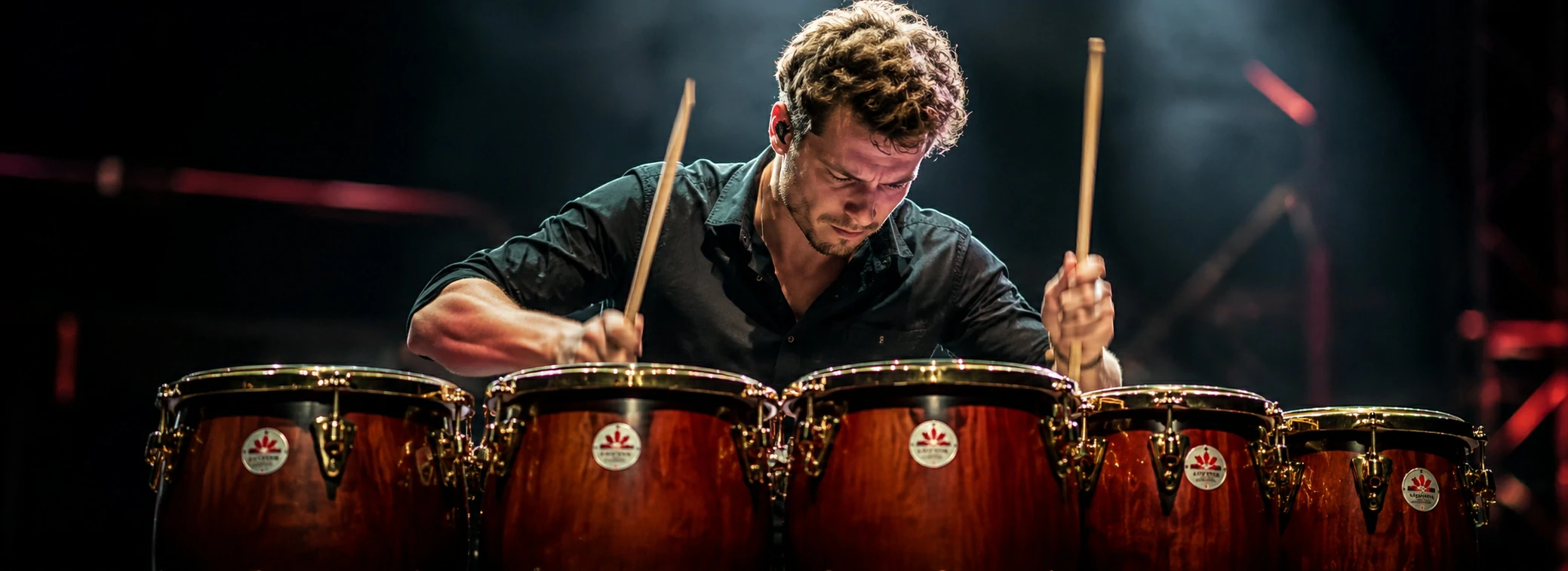
The Wuyin Pai Gu is a modern Chinese pitched percussion instrument consisting of five tuned drums mounted on a rack. As both a rhythmic and melodic instrument, its technique synthesizes traditional Chinese drumming methods, Western percussion fundamentals, and idiomatic approaches developed specifically for multi-drum rack systems. This article outlines the core performance techniques involved in playing the Wuyin Pai Gu, categorized by stroke types, rhythmic execution, pitch control, movement, and expressive practices.
2. Basic Stroke Techniques
2.1 Single Stroke
The most fundamental stroke: alternating left and right stick contacts on a drumhead.
Executed with controlled wrist motion; fingers provide guidance rather than force.
Can be played at varying dynamic levels, from pianissimo to fortissimo.
Forms the basis for rolls, accents, and melodic articulation.
2.2 Alternating Strokes (Alternating Single Strokes)
Rapid succession of single strokes using both hands interchangeably.
Essential for maintaining evenness across different drums and for building speed in scalar passages.
Emphasis is placed on consistent stick height, contact point, and rebound.
2.3 Double Stroke (Controlled Double Stroke Roll)
Two consecutive strokes per hand (RRLL or LLRR) executed with controlled rebound.
Used for slower rolls, rhythmic emphasis, or preparatory technique before open rolls.
Requires wrist flexibility and awareness of stick bounce characteristics on hide heads.
2.4 Open Roll (Multiple Bounce Roll)
A continuous roll achieved by allowing the stick to rebound multiple times per stroke, creating a sustained sound.
On the Wuyin Pai Gu, rolls are used to sustain a pitch, build crescendo, or blend with orchestral texture.
The density of the roll is controlled by stroke pressure and wrist speed; the natural hide’s response differs from synthetic heads, requiring adaptive touch.
2.5 Accented Strokes
A louder, more forceful stroke preceded or followed by weaker ones.
Accents are crucial for rhythmic drive, phrase marking, and mimicking articulations in melodic lines.
Achieved by increased stick height, fuller arm involvement, and firmer wrist snap.
2.6 Ghost Notes / Soft Strokes
Very light, subtle strokes used for inner rhythmic detail or preparatory motion.
Important in complex cross-rhythms and when transitioning between drums silently.
3. Contact Point and Sound Control
3.1 Center vs. Edge Striking
Near-center strikes produce a fuller fundamental with more low-end and sustain.
Near-edge strikes yield a brighter attack with more overtone content and quicker decay.
Players choose contact points deliberately to shape tone color for melodic clarity or textural variation.
3.2 Stick Angle and Attack
The angle at which the stick meets the head influences timbre and head longevity.
A perpendicular strike maximizes rebound and even vibration.
Slightly angled strikes (common in traditional Chinese grip adaptations) can emphasize certain overtones.
Use of matched grip (both hands holding sticks identically) is standard; some players adapt traditional Chinese grip (thumb-supported) for specific expressive needs.
3.3 Dynamic Gradation
Precise control from ppp to fff is required, especially in solo and orchestral contexts.
Dynamics are managed through stick height, velocity, arm–wrist–finger coordination, and choice of mallet hardness.
4. Pitch-Related Techniques
4.1 Melodic Playing Across Drums
Performing scales, arpeggios, and motifs by moving laterally across the five tuned drums.
Requires coordinated limb movement, spatial awareness, and pre-planning of hand assignments.
Similar in concept to keyboard percussion or timpani glissandi, but with discrete pitch steps rather than continuous pitch.
4.2 Interval Leaps and Hand Crossings
Large intervallic jumps between non-adjacent drums necessitate fluid arm movement and sometimes crossing hands.
Economy of motion is critical to avoid unnecessary travel and maintain rhythmic precision.
4.3 Pitch Bending (Traditional Hide Response)
On drums with natural hide heads, applying hand pressure near the head’s edge (between strokes or during rolls) can slightly lower pitch.
This technique, borrowed from older drum traditions, is used sparingly for expressive inflection but is less precise than on variable-pitch instruments like timpani.
4.4 Dampening (Muffling)
Stopping or shortening the vibration of a drumhead after a stroke to articulate clearly or prevent unintended resonance.
Executed by:
Leaving the stick on the head briefly after stroke (stick dampening)
Using the non-playing hand’s fingers or palm to touch the head
Arm or wrist contact in rapid passagework
Essential for clean melodic lines and polyrhythmic clarity.
5. Movement and Ergonomics on the Rack
5.1 Lateral Traversal
Moving both hands along the rack from low-pitched (larger) to high-pitched (smaller) drums and vice versa.
The rack’s curvature and tilt are adjusted so traversal feels natural; players often practice scales in repeated patterns to build muscle memory.
5.2 Stationary vs. Traveling Position
In some passages, one hand remains on a drum for repetition while the other moves (stationary anchor).
In scalar runs, both hands travel together in parallel or alternating patterns.
5.3 Body Posture and Reach
Standing or seated positions are possible; standing allows freer movement across the rack, while seated (common in Chinese orchestra pit) demands compact, efficient motions.
The rack height is set so forearms are roughly parallel to the floor when striking, minimizing strain.
6. Rudimental and Ornamental Techniques
6.1 Flam and Drag
Flam: A grace note very close to the main note, creating a thick attack.
Drag: Two quick grace notes before a main stroke.
These rudiments, adapted from Western drumming, appear in contemporary Wuyin Pai Gu repertoire for rhythmic complexity.
6.2 Paradiddle Applications
Single and double paradiddles (R L R R / L R L L etc.) are used to navigate cross-drum patterns efficiently, especially when the hand-leading pattern aids spatial movement.
6.3 Buzz Rolls and Press Rolls
Controlled multiple-bounce rolls with sustained pressure; differ from open rebounding rolls in density and texture.
Useful for sustained tones beneath melodic lines in orchestra.
6.4 Rim Shots and Wood Blocks Effects
Striking the head and hoop simultaneously (rim shot) produces a cutting, articulate sound for accents.
Occasionally, players strike the wooden shell (carefully) for a woody ancillary sound, though this is rare and instrument-specific.
7. Expressive and Interpretive Techniques
7.1 Crescendo and Diminuendo on Rolls
Gradually increasing or decreasing stroke energy and roll density to shape a phrase.
A hallmark of expressive Wuyin Pai Gu playing, especially in lyrical solo sections.
7.2 Articulative Phrasing
Treating drum melodies with bowed-string or wind-like phrasing: grouping notes, tapering ends, emphasizing structural notes.
Achieved through subtle dynamic shaping, slight timing nuances (within ensemble cohesion), and dampening control.
7.3 Call-and-Response and Dialogic Playing
In ensemble or solo-with-accompaniment works, the player may use contrasting drums (e.g., low vs. high) to simulate dialogue, varying timbre and register.
7.4 Extended Techniques (Contemporary Repertoire)
Some modern compositions call for:
Hand playing (palm/fingers) on heads for softer, non-stick tones
Mallet changes (using different stick tips: wood, felt, leather) mid-performance
Brush or bundled mallet effects for textural contrast
Simultaneous head-and-shell excitation (very controlled)
8. Repertoire-Specific Technical Demands
Traditional-style pieces: Emphasize power, clear rhythm, ornamental flourishes, and integration with gong/cymbal patterns.
Solo concertos: Demand virtuosic speed, wide dynamic range, precise pitch accuracy, and sustained lyrical control.
Orchestral parts: Focus on ensemble blend, cue responsiveness, balanced voicing, and often repetitive but exacting patterns.
Fusion/world music: May incorporate cross-genre grips, syncopations, and hybrid rudiments from jazz, marching, or global percussion.
9. Practice and Training Components
To master Wuyin Pai Gu technique, players typically work on:
Stick control exercises (single/double/triple strokes, dynamics)
Scale and interval patterns across drums
Rudimental drills adapted to rack layout
Sight-reading melodic percussion notation with pitch
Coordination between hands and spatial movement
Listening training for pitch, overtone balance, and ensemble intonation
Ergonomic awareness to prevent repetitive strain
10. Summary of Core Technique Categories
Category | Key Techniques |
|---|
Stroke Fundamentals | Single, alternating, double, open roll, accented, ghost |
Sound Control | Center/edge contact, angle, dynamic gradation |
Pitch & Melody | Cross-drum scales, leaps, dampening, pitch bend |
Movement | Lateral traversal, anchored hand, posture |
Rudimental | Flam, drag, paradiddle, buzz roll |
Expressive | Crescendo/diminuendo, phrasing, timbral contrast |
Extended | Hand playing, mallet change, brush use |
11. Conclusion
The technique of the Wuyin Pai Gu is multidimensional, integrating percussive stroke mechanics, melodic pitch navigation, spatial ergonomics, and expressive interpretation. It requires not only the power and control associated with traditional Chinese drumming but also the pitch sensitivity and coordination found in Western tuned percussion. As repertoire continues to expand, the technical vocabulary of the instrument evolves, reinforcing its role as a sophisticated melodic-rhythmic voice in contemporary Chinese and global music.