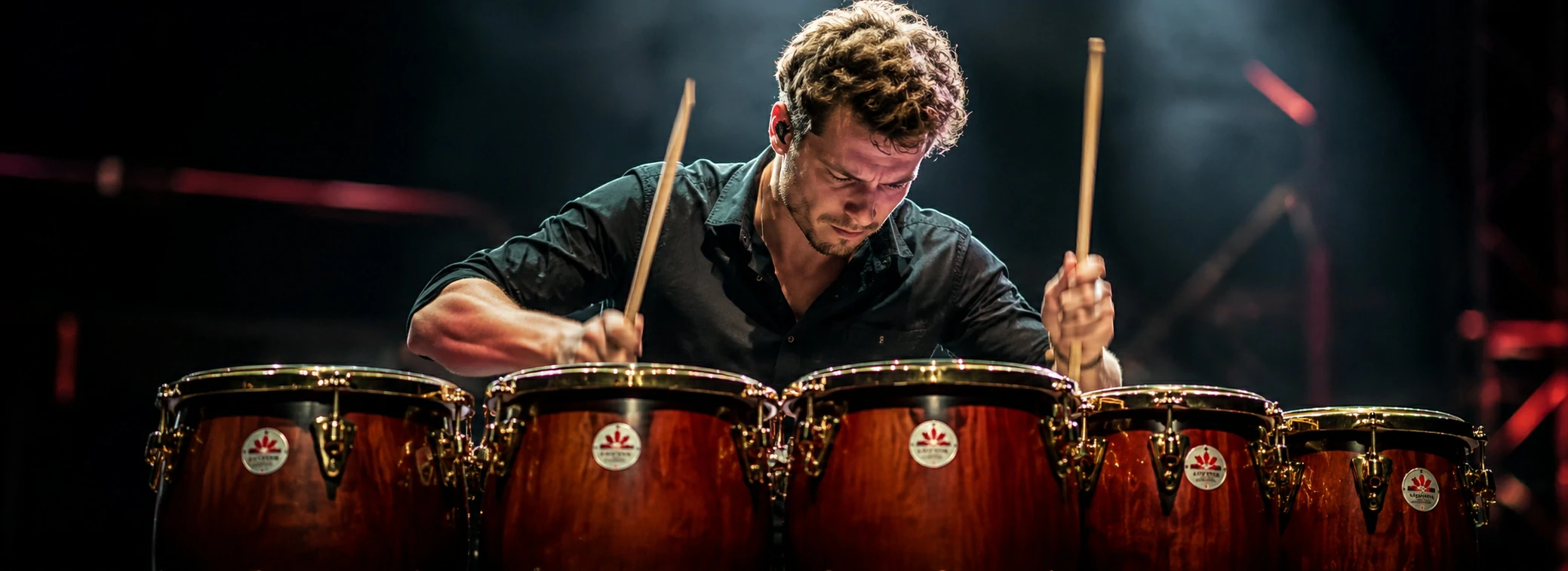
The Gaoyin Tanggu , or High-Pitched Hall Drum, is the smallest and brightest member of the Chinese Tanggu family. While large Tanggu rely on mass and depth for low-end resonance, the Gaoyin Tanggu derives its voice from its compact dimensions, which dictate pitch, articulation, sustain, and projection. Selecting the correct size is not merely a matter of physical space—it is a decision that defines the drum’s musical role, from crisp ornamental accents to agile melodic support. This guide analyzes the standard dimensional ranges and provides a framework for choosing the optimal size for specific performance contexts.
2. Fundamental Dimensional Parameters
Two measurements define the Gaoyin Tanggu:
Head Diameter: The primary determinant of fundamental pitch. Smaller = higher pitch.
Shell Depth : Influences sustain, low-mid body, and the "shape" of the resonance.
Unlike the deep-barreled Da Tanggu, the Gaoyin Tanggu usually maintains a more proportional or moderately shallow depth to preserve brightness and quick decay.
3. Standard Size Classifications and Their Characteristics
3.1 Compact / Chamber Size (≈20–25 cm / 8–10 inches)
Acoustic Profile:
Pitch: Very high, penetrating, and "pingy."
Sustain: Extremely short decay; highly articulate.
Timbre: Minimal low-mid body; emphasizes the initial attack and high-order overtones.
Best Suited For:
Chamber Ensembles: Where a full-sized Tanggu would overpower delicate strings/winds.
Practice / Private Study: Manageable volume and physical footprint.
Ornamental Playing: Rapid, intricate patterns where note separation is critical.
Folk Sub-genres: Certain regional styles requiring a "crisp" rather than "booming" voice.
Limitations: Lacks the weight to support a large orchestra; can sound thin in big halls.
3.2 Standard Orchestral / Ensemble Size (≈25–30 cm / 10–12 inches)
Acoustic Profile:
Pitch: Bright and high, but with added fullness compared to the <25 cm size.
Sustain: Controlled but audible bloom; enough ring to blend with a Suona or Guanzi.
Timbre: Balanced brightness with a slight low-mid foundation, allowing it to cut through without sounding tinny.
Best Suited For:
Chinese Orchestra (Minzu Yuetuan): The most common professional choice. It balances projection with tonal refinement.
Opera Accompaniment (Jingju/Kunqu): Provides clear cues and rhythmic drive without masking vocals.
General Ensemble Use: Versatile enough for both aggressive strokes and softer articulations.
Note: This is widely considered the sweet spot for most serious players.
3.3 Extended / Full-Body Size (≈30–35 cm / 12–14 inches)
Acoustic Profile:
Pitch: Still high-pitched relative to a Da Tanggu, but approaching the lower threshold of the "high" register.
Sustain: Noticeably longer; more internal air resonance due to increased diameter/depth.
Timbre: Richer, warmer, with more low-mid presence. Less "crack," more "thump" with brightness on top.
Best Suited For:
Outdoor / Large Venues: The extra body carries better over distance and ambient noise.
Players Transitioning from Da Tanggu: Those who want a high drum but prefer more substance and less extreme brightness.
Solo Work: Where a wider dynamic and tonal range is needed on the high drum itself.
Considerations: May be too "fat" for traditional high-pitched ornamentation; overlaps tonally with a small mid-range drum.
4. The Depth-to-Diameter Ratio (Proportionality)
Beyond raw diameter, the depth modifies the sound:
Shallow Depth (Relative to Diameter):
Emphasizes attack and dryness.
Reduces internal air cavity resonance → faster decay.
Ideal for staccato, articulate playing (e.g., opera signaling).
Deeper Depth (Relative to Diameter):
Enhances sustain and low-mid warmth.
The air column inside vibrates more → longer ring.
Better for sustained rolls, melodic phrases, and orchestral blending.
Selection Tip: For a 28 cm diameter Gaoyin Tanggu:
A depth of 15–18 cm yields a crisp, agile drum.
A depth of 20–25 cm yields a more singing, resonant drum.
Always check the manufacturer’s specs: a "28 cm drum" can sound very different at 15 cm depth vs. 22 cm depth.
5. Context-Based Selection Framework
Ask these questions to narrow your size:
Where will it be played?
Small studio / home: ≤25 cm.
Concert hall / orchestra pit: 25–30 cm.
Outdoor plaza / parade: 30–35 cm.
What is the musical role?
Ornamentation / fast figures: ≤25 cm (prioritize decay speed).
Rhythmic foundation + melody: 25–30 cm (balance).
Projection + warmth: 30–35 cm.
Who is the player?
Child / small stature: ≤25 cm (easier reach, lighter weight).
Adult professional: 25–30 cm (standard ergonomic fit).
What is the ensemble texture?
Dense (many gongs/cymbals): 25–30 cm+ (needs cut-through).
Transparent (solo + strings): ≤28 cm (avoid overpowering).
6. Compatibility with Existing Sets
If you own a Da Tanggu (e.g., 50–60 cm) and perhaps a Zhong Tanggu (mid, e.g., 35–40 cm):
The Gaoyin should bridge the gap without overlapping too much.
A 30–35 cm Gaoyin might blur the line with a 35 cm Zhong.
A 25–28 cm Gaoyin creates a clearer pitched trio: Low (50–60) / Mid (35–40) / High (25–28).
Rule of Thumb: Aim for a diameter gap of at least 10–15 cm between successive Tanggu sizes to maintain distinct pitch registers.
7. Physical and Ergonomic Considerations
Weight: A solid wood 35 cm Gaoyin Tanggu is significantly heavier than a 20 cm one. Consider transport and stand stability.
Reach: On a rack or stand, smaller diameters allow closer spacing for rapid cross-drum patterns. Larger high drums may require a wider stance.
Stand Fit: Verify your stand/cradle accommodates the chosen diameter range (some cradles max out at 30 cm).
8. Summary Size-Context Matrix
Diameter (cm) | Diameter (inch) | Pitch Character | Ideal Context | Caveat |
|---|
20–25 | 8–10" | Very High, Crisp | Chamber, Practice, Ornamentation | Thin tone in large halls |
25–30 | 10–12" | Bright, Full | Orchestra, Opera, General Pro | Standard; verify depth |
30–35 | 12–14" | High-Warm, Resonant | Outdoor, Solo, Large Ensemble | May overlap mid-range |
9. Conclusion
Choosing a Gaoyin Tanggu size is an exercise in balancing acoustic necessity with contextual reality. The 25–30 cm (10–12 inch) range represents the professional standard, offering the brightness expected of a high drum with enough body to function in a Chinese orchestra. Smaller sizes serve specialized niches of clarity and compactness, while larger sizes push into a more robust, projective territory. By evaluating your venue, repertoire, ensemble size, and ergonomic needs—and paying close attention to the depth-to-diameter ratio—you can select a Gaoyin Tanggu whose dimensions unlock its intended voice: crisp, penetrating, and distinctly articulate within the rich tapestry of Chinese percussion.