1. Overview
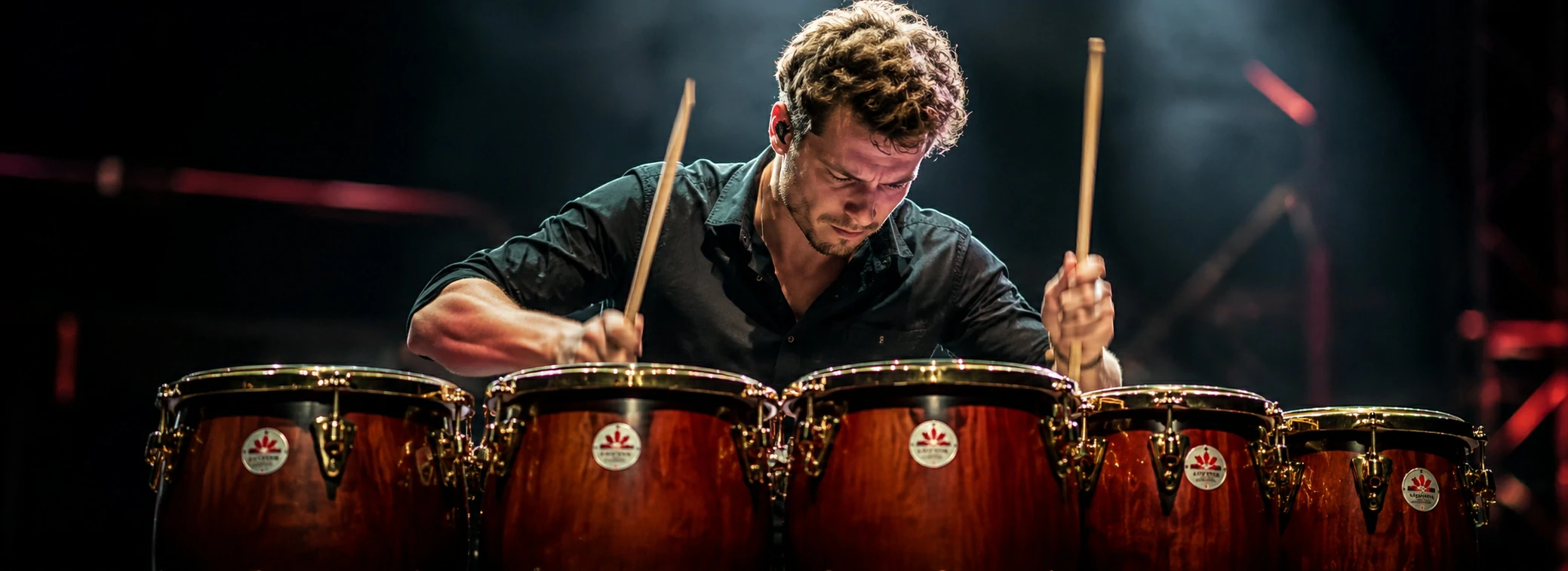
The Wuyin Pai Gu (literally “Five-Tone Rack Drums”) is a modern Chinese percussion instrument consisting of five tuned drums mounted on a single stand or frame. To classify it accurately, one must examine its acoustic properties, cultural origin, structural design, and functional role in musical performance.
2. Classification by Acoustic Principle
From the perspective of acoustics and organology (the study of musical instruments), the Wuyin Pai Gu belongs to the membranophone family.
Membranophone: Sound is produced primarily by the vibration of a stretched membrane (drumhead) when struck.
Unlike idiophones (which vibrate as a whole body, e.g., gongs, woodblocks) or chordophones (string instruments), the Wuyin Pai Gu relies entirely on skin vibration for sound generation.
Each of the five drums has a tunable head, usually made of water buffalo hide or cowhide, stretched over a wooden or composite shell.
Thus, in standard ethnomusicological classification systems (such as Hornbostel–Sachs), it is categorized as a set of tuned membranophones.
3. Classification by Pitch Characteristics
A key feature distinguishing the Wuyin Pai Gu from many traditional Chinese drums is its definite pitch.
Pitched / Tuned Percussion: The five drums are typically tuned to a pentatonic or diatonic scale, allowing melodic and harmonic performance—similar in concept to timpani, rototoms, or the timpani–drum hybrid in Western percussion.
Contrast with Unpitched Drums: Traditional Chinese drums such as the Da Tang Gu or Bangu are largely unpitched or loosely pitched, functioning mainly for rhythm, accent, and color.
Therefore, within percussion families, the Wuyin Pai Gu occupies a middle ground: it is a pitched membranophone or melodic drum set.
4. Classification by Cultural and Historical Context
Chinese Traditional / National Instrument (Modern Developed):
Although rooted in Chinese drum-making traditions, the Wuyin Pai Gu was developed in the late 20th century (1970s–1980s) by Chinese percussionists and instrument makers to meet the needs of the modern Chinese orchestra.
It is considered a modern innovation within the Chinese traditional instrument system, rather than an ancient folk instrument.
It inherits the craftsmanship of drums like the Tanggu and Huapen Gu but adds chromatic/tonal organization inspired partly by Western tuned percussion (e.g., timpani, marimba).
So culturally, it is classified as a contemporary Chinese orchestral percussion instrument.
5. Classification by Structural Arrangement
Rack Drum / Multi-Drum Set: The five drums are arranged horizontally on an adjustable frame, allowing the player to perform with sticks across different pitches rapidly.
This places it in a category similar to:
Rototoms or octobans in Western drum kits,
Pahu or rack-mounted barrel drums in other Asian traditions,
But with a distinctly Chinese tonal aesthetic and scale system.
It is thus also described as a chromatically/pentatonically arranged drum rack.
6. Classification by Functional Role in Ensemble
Orchestral Percussion: In a Chinese orchestra, it serves both rhythmic and melodic functions.
Solo Instrument: Due to its pitch range and technical possibilities, it is also established as a solo concert instrument.
Ensemble Color Instrument: It bridges pure rhythm (unpitched drums) and melody (pitched percussion like the marimba or paixiao in terms of function, not mechanism).
7. Summary of Classifications
Classification Basis | Category | Description |
|---|
Acoustic (Hornbostel–Sachs) | Membranophone | Sound from vibrating stretched membrane |
Pitch Property | Pitched / Tuned Percussion | Definite pitch, usually pentatonic or diatonic |
Cultural Origin | Modern Chinese Orchestral Instrument | Developed in China in the late 20th century |
Structural Form | Rack-mounted Multi-Drum Set | Five drums on one stand |
Ensemble Function | Melodic-Rhythmic Percussion | Combines rhythm and melody in Chinese/world music |
8. Conclusion
The Wuyin Pai Gu is best described as:
A modern Chinese pitched membranophone, arranged as a five-drum rack set, designed for both melodic and rhythmic roles in Chinese orchestras, solo performance, and cross-cultural percussion ensembles.
It represents a unique fusion of traditional Chinese drum craft and contemporary musical demands, occupying a specialized niche between unpitched rhythmic drums and melodic percussion instruments.