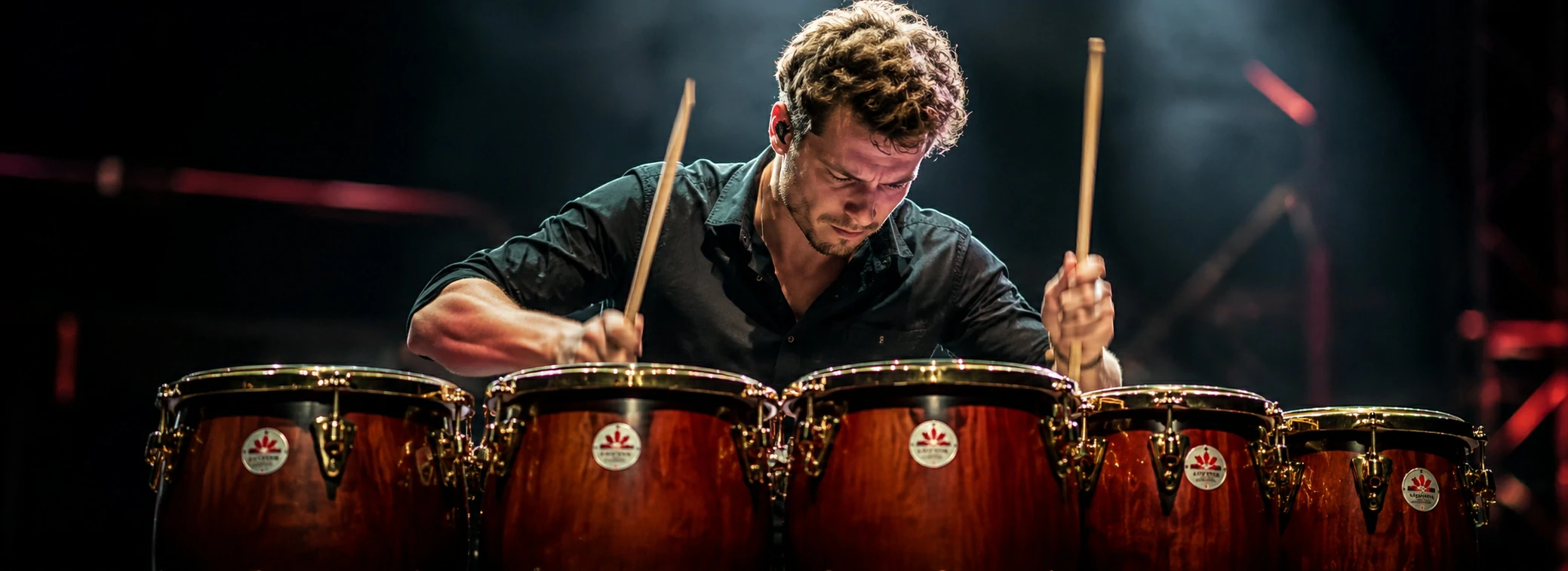
This is the primary designed context for the instrument.
Melodic and Harmonic Roles: Unlike traditional unpitched drums, the Wuyin Pai Gu is tuned (usually in a pentatonic or diatonic scale), allowing it to play melodies, arpeggios, and counterpoint within a Chinese orchestra setting.
Orchestral Texture Building: It fills the mid-to-low percussion register, bridging the gap between small hand drums (e.g., Bianzhong or Linggu) and large suspended drums.
Solo Repertoire: Several contemporary compositions (e.g., The Herd Boy’s Flute arrangements or Drumming in the Sun) feature the Wuyin Pai Gu as a solo instrument with orchestral accompaniment, showcasing rapid rolls, glissandi (via pitch bending), and virtuosic sticking patterns.
2. Traditional Opera and Theater (Xiqu)
While traditional opera relies heavily on fixed-function drums (like the Bangu), modern experimental or reconstructed opera productions incorporate the Wuyin Pai Gu for enhanced dramatic effect.
Atmospheric Scoring: Its ability to produce sustained rolls and tonal drones supports scene transitions and emotional climaxes.
Hybrid Ensembles: In fusion opera troupes that combine Western instruments with Jingju (Peking Opera) elements, the Wuyin Pai Gu provides a familiar yet expanded sonic palette that blends better with harmonic accompaniment than unpitched drums.
3. Contemporary Fusion and Cross-Cultural Music
The instrument’s chromatic potential makes it attractive in genre-crossing contexts.
Chinese-Western Fusion: Collaborations with symphony orchestras, jazz big bands, or electronic ensembles benefit from its tuned resonance, which can be mic’d and mixed like a melodic percussion instrument (similar to timpani or rototoms).
World Music Ensembles: In global percussion groups, the Wuyin Pai Gu complements instruments like the West African djembe, Latin timbales, or Indian tabla by adding a pitched East Asian voice.
Film and Game Scoring Sessions: Live recording sessions for soundtracks with Chinese themes often use the Wuyin Pai Gu for thematic motifs that require both rhythmic drive and identifiable pitch.
4. Academic and Conservatory Education
Music institutions across China and internationally use the Wuyin Pai Gu as a teaching tool.
Technique Development: Students learn traditional Chinese grip, rudiments, and repertoire while also practicing melodic sight-reading on drums—a rare skill in traditional Chinese percussion.
Ensemble Training: It teaches percussionists how to listen for intonation and blend within a pitched ensemble, bridging the gap between trap-set drumming and melodic percussion (like marimba or vibraphone).
Research and Preservation: Conservatories use the instrument to study the evolution of Chinese percussion from ritual objects to orchestral tools.
5. Solo Recitals and Competitions
The Wuyin Pai Gu has established itself as a viable solo instrument.
Competition Repertoire: National Chinese music competitions (e.g., CCTV Chinese Instrumental Competition) include categories where the Wuyin Pai Gu is performed solo or with piano accompaniment.
Recital Programming: Its visual layout and tonal variety make it engaging for solo audiences, especially when combined with lighting and staged movement.
Virtuosic Showpieces: Composers write technically demanding works involving rapid cross-drum patterns, dampening effects, and dynamic contrasts that highlight the performer’s control.
6. Cultural Events, Ceremonies, and State Functions
Due to its impressive visual rack and authoritative sound, the instrument is often selected for formal occasions.
Opening and Closing Ceremonies: Large-scale events (e.g., National Day celebrations, international festivals) use multiple Wuyin Pai Gu players for synchronized rhythmic statements.
Diplomatic and Cultural Exchange: When representing Chinese music abroad, the instrument signals modernity within tradition—showing that Chinese percussion has evolved beyond archaic rhythm keeping.
Televised Galas: Its rack-mounted format is camera-friendly, and the pitched drums allow pre-tuned coordination with backing tracks.
7. Recording Studios and Multimedia Production
In controlled environments, the Wuyin Pai Gu offers practical advantages.
Tuning Consistency: Unlike rope-tuned traditional drums, modern Wuyin Pai Gu often uses mechanical lugs, making it easier to maintain pitch across recording sessions.
Mic Placement Flexibility: The open rack design allows close-miking of individual drums for layered percussion tracks in pop, rock, or cinematic production.
Sound Design: Producers may use processed Wuyin Pai Gu samples for hybrid electronic tracks needing an “organic East Asian pulse.”
8. Amateur Ensembles and Community Groups
While primarily a professional instrument, it appears in advanced amateur contexts.
University Chinese Music Clubs: Institutions with strong East Asian studies programs may acquire a set for cultural performance.
Drum Corps and Percussion Ensembles: Adapted arrangements allow the Wuyin Pai Gu to sit alongside Western battery percussion in educational marching or indoor ensembles.
9. Limitations and Contextual Considerations
Understanding where it is less suitable helps define its niche:
Strict Ritual or Folk Contexts: In some traditional settings (e.g., temple drumming, Lion Dance), the unpitched, deeply resonant Da Tang Gu or specialized frame drums remain preferable for symbolic and acoustic reasons.
Small Venues or Intimate Acoustics: The rack’s footprint and volume may overwhelm very small spaces; a single small Tanggu or hand drum might be more appropriate.
Non-Pentatonic / Microtonal Repertoire: Standard Wuyin Pai Gu is tuned to fixed intervals; frequent microtonal adjustments are possible via head tension but less practical than on variable-pitch instruments like timpani.
10. Summary of Key Applicable Scenarios
Scenario | Primary Function | Why Wuyin Pai Gu Fits |
|---|
Chinese Orchestra | Melodic & ensemble percussion | Tuned, blends with harmonic texture |
Solo Performance | Virtuosic display | Wide pitch range, visual layout |
Fusion / World Music | Cross-cultural percussion | Chromatic potential, distinctive timbre |
Education / Conservatory | Technique & theory | Teaches pitch + rhythm integration |
Stage Ceremonies | Visual & sonic impact | Impressive rack, powerful projection |
Studio Recording | Layered percussion | Stable tuning, mic-friendly design |
Conclusion
The Wuyin Pai Gu occupies a unique position in the Chinese percussion family: it retains the visceral power of traditional drums while introducing melodic and harmonic functionality. Its applicability spans orchestral stages, academic classrooms, recording booths, and ceremonial platforms. As contemporary Chinese music continues to evolve, the instrument’s role is likely to expand further into cross-genre experimentation and global percussion practice.